
Handley Page Hampden
Handley Page developed a modern stressed-skin mid-wing monoplane, powered by Bristol Pegasus radial air cooled engines, with its first flight in 1936. It had the most advanced wings available at the time, giving it a remarkably low landing speed of 73 mph for an aircraft of its size, with a top speed of 265 mph. The Hampden had a short, narrow but tall main fuselage with a very slender tail unit. This configuration led to the nicknames "Flying Panhandle" and "Flying Suitcase". At the end of the war, no complete or partial Hampden aircraft were retained for museum display.
The Hampden went into service in August 1938 with No. 49 Squadron (RAF). A total of 1,432 Hampdens were built, 502 of them by Handley Page, 770 by English Electric and 160 in Canada by the Victory Aircraft consortium. Of the 160 built, 84 were shipped by sea to Britain, while the remainder came to Patricia Bay (Victoria Airport) B.C., to set up No.32 OTU (RAF). Due to heavy attrition from accidents, a number of "war weary" Hampdens were later flown from the U.K. to Pat Bay as replacements.
Typical exercises at 32 OTU consisted of patrolling up the West Coast of Vancouver Island at night or flying out into the Pacific to a navigational map coordinate, often in adverse and unforecast weather.
During operations, the Hampden proved to have serious deficiencies, particularly in its defensive armament, which consisted of five 0.303 inch machine guns. The fixed forward firing gun proved almost useless and the single guns in the nose, dorsal and ventral positions had limited transverse, leaving a number of blind spots. In addition, the cramped conditions led to crew fatigue on long flights, and it was almost impossible for crew members to gain access to each others cockpit in an emergency. Losses during early daylight raids were very heavy.
To improve the defensive armament, the dorsal and ventral positions were each fitted with twin Vickers K machine-guns. In addition, armor plate was installed and flame-damping exhaust pipes were fitted for night flying. Thus modified, the Hampden did useful work in Bomber Command's night offensive from 1940 to 1942, taking part in the RAF's first raid on Berlin and in the 1,000-bomber raid on Cologne. Several overseas RCAF squadrons flew the Hampden, as a bomber and torpedo-bomber.
P5436 was one of the Canadian-built Hampdens. It survived only 100 hours of flying time before crashing near Patricia Bay, on November 15th, 1942, while engaged in torpedo dropping practice. The pilot made the error of turning at low speed and altitude, causing the aircraft to fall into a "stabilized yaw", a known Hampden flaw. The aircraft quickly sank 600 feet to the bottom. The 4-man crew was more fortunate, as the pilot of a passing Stranraer flying boat had seen the mishap, and they were plucked out of the water, with very minor injuries, within minutes.
In the 1980's, CMF salvaged the remains of Hampden AN136 from Mt. Tuam on Saltspring Island, and a later AN132 from a mountaintop near Ucluelet. Our underwater recovery crew was aware of P5436, but the exact location continued to elude SONAR and underwater cameras. In 1985, some detective work into wartime RCAF files pinpointed the depth of the wreck, and this was almost immediately rewarded by some beautiful SONAR views of a complete Hampden!

Although fairly complete and mostly intact, the aircraft was badly corroded, damaged, and very fragile, making for a difficult salvage operation that was carried out by a remote controlled submarine aided by video camera. Considering that more than 44 years were spent in salt water, some small components were in magnificent shape. The compass worked, there was air in the tires and greased bearings and drive chains moved freely.

The difficult and costly salvage operation was carried out by Jerry Olsen and his crew of C-LOST (Canadian Lake and Ocean Salvage Team), the Thompson Family of Tillicum Towing of Pender Harbour and International Submarine Engineering who loaned the technical equipment.

Restoration work was driven mainly by volunteer Fred Gardham, who worked on Hampdens in the local aviation industry during WWII, and who had even logged one flight in P5436 following repairs. Vital components from the other two Hampden crash sites were used in the rebuild.

Technical Details:
(Photo credit: J. Inksater)


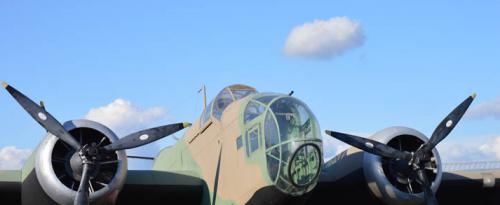
The Hampden restored.
(Photo credit: Raymond Chouinard)
Progress Report, March 2011.
The repair on the Hampden took a great leap forward on March 5 when the repaired left inner wing was joined to the fuselage. With the BCIT team supervising the proceedings and with crane operator Dustin Yanish using his controls to within a mm the wing was swung into place. The attaching bolts were tapped into place and the job was complete. The excitement was evident among the reconstruction team and the Museum onlookers at this step to bring the Hampden back to its former display glory. The team could not rest there, however, and also placed the propeller on the engine by the end of the day.


The talented reconstruction team; Crane operator Dustin Yanish,
with BCIT students Murat Subasioglu, Jeff Yeoll and Renya Chang.
How do you say a big "Thank You" to the team? How about a flight in the Museum's Harvard II? "Yes!" was the response. The next day pilot Bill Findlay cranked up the big yellow bird and took the three team members (Jeff Yeoll, Renya Chang and Murat Subasioglu) for a fly among the snow-covered mountains of the Fraser Valley. First they viewed the mountains looking down through the canopy, then they saw the mountains describe a circle around the canopy as the Harvard did what it does best - aerobatics. The big smiles at the end of the day tell the story!

Jeff showing his enthusiasm at the end of the Harvard ride.
Progress Report, October 2010.
A temporary shelter has now been erected to assist in the restoration effort. Volunteers from the British Columbia Institute of Technology's Aerospace Technology Campus (www.bcit.ca/about/aerospace.shtml) are making steady progress.

Progress Report, May 2010.
The damaged wing has been dismantled and repairs are making steady progress. A temporary shelter will soon be in place to allow a more consistent effort in the Rain Forest climate of this area. Do you have expertise in sheet metal work - not necessarily on aircraft? The Museum would love to hear from you.

The Hampden suffered structural damage during a snowfall in late 2008 resulting in the collapse of the left wing. The wing has now been removed and is being repaired by members of the University of the Fraser Valley.

HEAVY SNOWFALL DAMAGES HISTORIC AIRCRAFT – December 28, 2008

Despite the best efforts of Museum volunteers the recent extreme weather in the lower mainland has caused considerable damage to some exhibits at the Canadian Museum of Flight in Langley, BC. Hardest hit is the Museum’s Handley Page Hampden, a World War 2 bomber that was raised from the oceans depths off Vancouver Island in 1985.
Ongoing efforts to clear the rapidly accumulating snow from the wings of the aircraft were overwhelmed during the night of December 26 when a failure of the left wing internal structure occurred as a result of the weight of the snow on the wing. The wing separated from the fuselage and collapsed onto an adjacent display case containing one of the aircrafts original engines. The wing itself suffered considerable damage at both the root and tip. Further damage is visible on the tail of the aircraft although a full investigation of this area has yet to be completed.
The Museum’s Hampden is the sole survivor of its type on display anywhere in the world although another example was recovered from a crash site in Russia and is under restoration in Britain. The twin engine Hampden was part of the Royal Air Force’s front line equipment at the start of World War 2 but was soon rendered obsolete and retired from active operations against Nazi Germany during the summer of 1943.
One hundred and sixty Hampdens were built in Canada during WW2 and many were used on the west coast to train crews in the difficult missions of attacking enemy shipping with torpedoes. The Museum's aircraft was lost on just such an exercise on November 15, 1942 when it crashed into the ocean moments after dropping a practice torpedo. Following its recovery the aircraft was the subject of a long and challenging restoration to static display condition which was completed in 1998.
It is anticipated that a lengthy program of repair will be required to put the airplane back into displayable condition and the Museum is putting out a plea for the public's assistance in providing both financial and practical support to help re-build this important piece of Canadian history.